




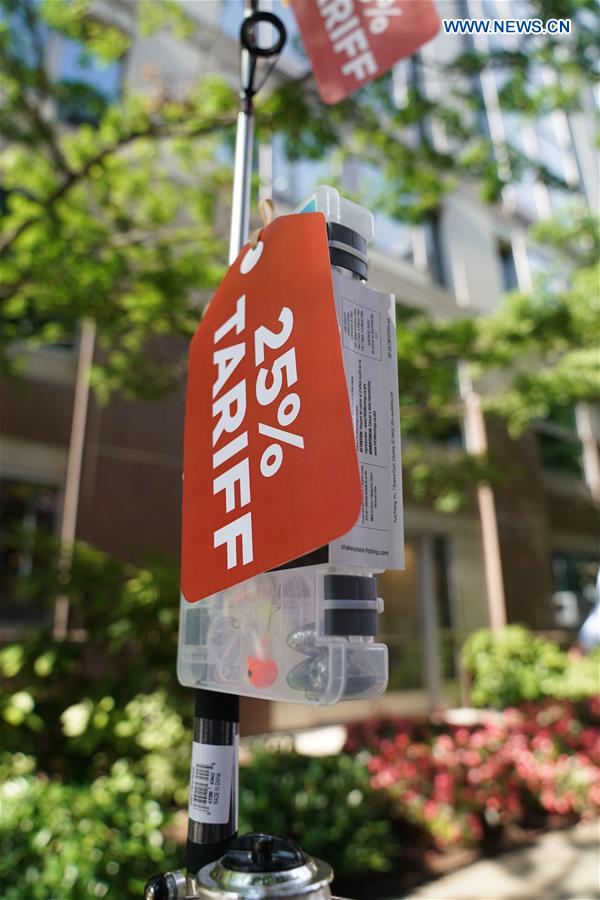
Photo taken on June 17, 2019 shows anti-tariff posters on a fishing rod in Washington D.C., the United States. (Xinhua/Liu Jie)
by Xinhua writers Sun Ding, Xiong Maoling, Deng Xianlai
WASHINGTON, June 25 (Xinhua) -- A cash bonanza seems stuck in limbo for Powercharge, a North Carolina-based lithium-ion cell phone accessory company, as proposed additional U.S. tariffs on Chinese goods loom on the horizon.
A disturbing 25-percent tariff, if it happens, would stifle a potential deal, said Brett Portaro, co-founder of the start-up. It just had received a verbal commitment to its first large order from a major brick-and-mortar U.S. retailer last week. To obtain the opportunity, Portaro has been working hard.
Now as the very last witness of the seven-day hearings regarding the tariff hikes on 300 billion U.S. dollars' worth of Chinese products, Portaro aims to take control of his own destiny.
During the hearings that concluded here Tuesday, more than 300 business and industry representatives from a broad range of sectors, most of which matter to American families' daily life, made their case against the threatened tariff hikes, a battle for prospects, or even for survival.
HARM ACROSS THE BOARD
"We have very loyal people who have worked for us for a very long time," said Rick Muskat, president of Deer Stags, a U.S. shoe company. "Their jobs are at stake."
Muskat's family-owned business would be in jeopardy due to Washington's latest trade protectionist move, as his company's shoes are mostly sourced from China.
The proposed new tariffs cover such industries as apparel and footwear, food and drinks, culinary, housing, safety, auto, electronics, sporting and recreation, and inflict harm on big and small businesses that rely upon Chinese supplies.
Ahead of the hearings, hundreds of U.S. companies and associations signed a letter to President Donald Trump, urging an abandonment of the tariff hikes, saying they "remain concerned about the escalation of tit-for-tat tariffs" between the world's top two economies.
"We know firsthand that the additional tariffs will have a significant, negative and long-term impact on American businesses, farmers, families and the U.S. economy," read the letter, released by Tariffs Hurt the Heartland, a U.S. nationwide anti-tariff campaign. "Tariffs are taxes paid directly by U.S. companies."
When it is estimated that existing tariffs on China have cost an average American family of four more than 800 dollars per year, the Tax Foundation, a Washington D.C.-based independent tax policy nonprofit, said the proposed tariffs would impose nearly 2,000 more dollars per year.
Major U.S. tech companies including Apple, Microsoft and Intel warned that the proposed tariffs would crimp innovation and competitiveness.
U.S. Senator Dianne Feinstein of California said she has heard from companies about the pain the tariffs are causing "by disrupting their supply chains and raising their costs of doing business in ways that damage their competitiveness and in some cases, threaten their existence."
Worse, when prices on safety products, including child car seats, get higher, it could put lives at risk.
"We are concerned that without affordable access to a safe car seat and safe sleep products parents may be forced into makeshift alternatives or go without protective products at all," said Lisa Trofe, managing director of the Juvenile Products Manufacturers Association, a national trade organization.
"Even one death of a child, due to unavailability of affordable life-saving baby products, is one too many," Trofe said.
CHINESE PARTNERS, CHERISHED FRIENDS
Steven Stokes, CEO of the Utah-based Propel Trampolines LLC, has a good relationship with a manufacturer in Qingdao, a city in eastern China. Its leader, "Mr. Lu" as Stokes calls him, is willing to "grow with us, support us, help us develop products, produce products."
"He's been a great partner to work with," Stokes told Xinhua. "It'd be very difficult to replace not only a partner but a friend like I have in Qingdao because those are long-term relationships."
Stories of success for a vast array of U.S. companies would have been pipe dreams had there been no Chinese participation. Considered reliable partners, they are also cherished as trustworthy friends.
China makes it viable to produce "appealing," "entertaining," and "exciting" children's books on a large scale, said Daniel Reynolds, CEO of Workman Publishing, a New York-based independent publisher.
"It's an investment, and ultimately a partnership, that has given Workman and other children's publishers the opportunity to create -- and bring to market at affordable prices -- innovative and high-quality products," Reynolds said.
In the current situation, solid partnerships between U.S. and Chinese companies have become more evident than ever.
Powercharge conducts research and development with a factory in Shenzhen, a tech hub in southern China. "Now typically it's more we're discovering what needs to be done, how can we improve those products, and then we work directly with the factory and say, okay, this is what we need to change in the software," Portaro told Xinhua.
"We have a great relationship," he said.
Jean Kolloff, CEO and founder of Quinn Apparel + QI Cashmere, said her New York-based company usually makes contracts for production as early as eight months prior to shipping, meaning prices get fixed from customers and vendors.
In the wake of the tariff threat, her Chinese partner, a cashmere manufacturer in eastern China's Anhui Province, has been working two shifts to "help us out," lest costs get too high for Kolloff.
"They are literally working around the clock 24 hours a day to complete my production, to get it on a boat or on a plane and get it to the U.S. before it happens," Kolloff said.
HOPE FOR TRADE AMITY
Feinstein, among others, has urged Washington to drop the "big stick" of tariffs and pursue "alternative approaches" to address trade issues with China.
Twenty-five-percent tariffs on some 250 billion dollars' worth of Chinese goods are in effect. China, in response, raised additional tariffs as retaliatory measures on a range of U.S. products.
Beijing and Washington had held 11 rounds of trade talks until the White House escalated trade tensions by unilaterally imposing additional tariffs on Chinese goods in May, stalling efforts from both sides that had yielded positive results.
Last week, Chinese President Xi Jinping held a telephone conversation with his U.S. counterpart Donald Trump at the latter's request, and agreed to meet with Trump during the upcoming Group of 20 (G20) summit in Japan, a silver lining in the prolonged U.S.-initiated trade disputes.
News about the two presidents' upcoming meeting is "certainly encouraging," said James M. Roberts, an economist at the Heritage Foundation, a Washington D.C.-based think tank.
"It is not surprising that markets have reacted favorably," Roberts said. "Assuming that the meeting stays on track, markets should continue to view the upcoming G20 hopefully."
Witnesses at the hearings expressed hopes that trade tensions would be properly managed and that bilateral trade and economic cooperation would return to normal.
Katherine Gold, whose family-owned company specializes in toddler shoes and socks, told Xinhua she expects the two sides to "come to some kind of a cooperative agreement" so that business and industry representatives won't have to fret about the threat of extra tariffs.
"I believe we will find a resolution to this," said Kerry Stackpole, CEO and executive director of Plumbing Manufacturers International, who testified against tariff hikes, while stressing long-time economic ties between the United States and China.
"Pretty much the entire planet is linked together in trade and commerce," said John Larned, founder of Global RFID Systems North America, a radio frequency identification solutions provider that sources finished components and products from China. "It all works much better when there are fewer impediments to trade."
"Through business, we become friends, we prosper together," Larned added.
(Xinhua reporters Liu Yang, Xu Yuan, Hu Yousong, Yang Chenglin, Gao Pan and Jin Yuelei in Washington also contributed to the report.)
(Video reporters: Hu Yousong, Sun Ding, Xiong Maoling; Video editor: Liu Ruoshi)
