




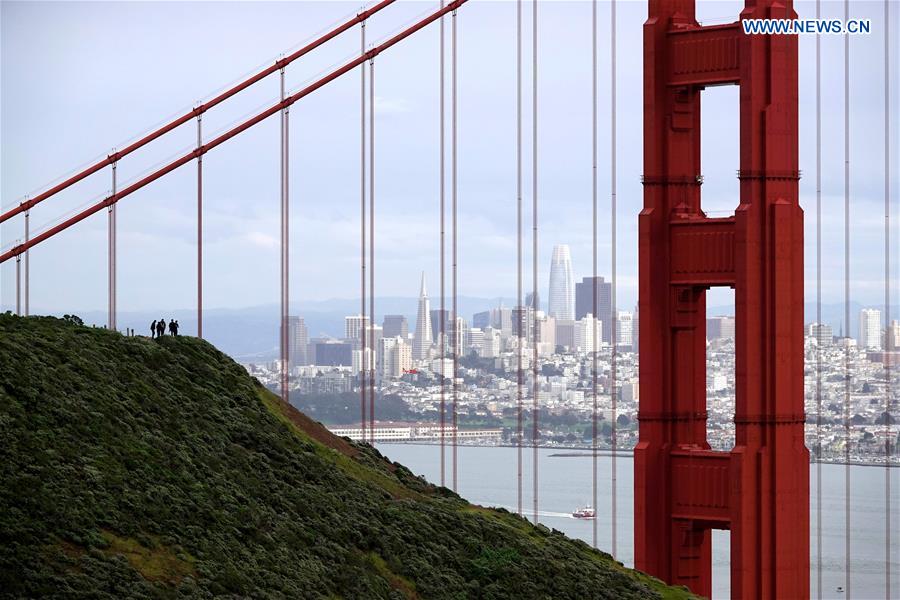
Photo taken on March 26, 2019 shows the Golden Gate Bridge and the city of San Francisco in the United States. (Xinhua/Wu Xiaoling)
by Xinhua writers Xia Lin, Wu Xiaoling, Gao Lu, Zhang Mocheng
SAN FRANCISCO, April 16 (Xinhua) -- High-tech giants on the U.S. West Coast have been eyeing central and eastern states for new headquarters and branches, which experts believe will eventually transform the country's social-economic structure, adding more chances of cooperation with China.
EASTWARD EXPANSION
"Talent, money and market," Del Christensen, chief of Global Business Development for the Bay Area Council (BAC), told Xinhua while explaining the phenomenon dubbed "eastward expansion" by U.S. media. BAC represents San Francisco Bay Area and Silicon Valley in public affairs and strategy management.
Among the first group to move eastward, Seattle-based e-commerce multinational Amazon had sought to split second headquarters between Long Island City in New York City and Crystal City in Arlington, Virginia.
Silicon Valley giant Google is expanding its NYC office by doubling the number of its staff, while Apple has announced plans to build a second campus in Austin, Texas.
With an investment of about 1 billion U.S. dollars, Apple's expansion will hopefully bring the city 15,000 jobs. Its first campus in Austin has already grown almost as big as the 5-billion-dollar Apple Park in Cupertino, California.
"I think the biggest one (reason), the most important one, is a quest for human capital," said James DeNicco, director of the Principles of Economics Program at Rice University.
Going for talent is the No. 1 consideration for Seattle and Bay Area's high-tech giants. They map out Austin, because top schools like University of Texas can be relied upon for sustainable high-level human resource, DeNicco told Xinhua.
Since late 1980s, the concentration of tech companies in Austin has brought the city a new nickname "Silicon Hills." The hilly city, with its growing academic and high-tech sectors, has since lived up to expectations.
Other big names in technology industry, including Uber, Facebook and LinkedIn, have also embarked on eastward expansions, driven by a common goal: hunting for talent. They mostly favor New York, Washington D.C., Boston and other already developed eastern cities.
On the other hand, Silicon Valley, where Google and Facebook were born and have been growing a lot, can't accommodate all their growth. So they have to find some other places, Jim Wunderman, BAC's president and CEO, told Xinhua.
"The Bay Area can only support so many people. The housing is already ridiculously expensive. Silicon Valley in the Bay Area will always have a special place in that world, and that's what makes it so expensive to live here," he said.
San Francisco, San Jose, Oakland and Seattle, bearing the blunt of the impact of those giants' growth, are the four most expensive major cities in America based on home values, according to The New York Times.
The Washington Post reported that Amazon's "explosive growth" has made it "Seattle's largest private employer and taxpayer in less than a decade," offering 45,000 jobs in a city of 725,000 people.
DeNicco took innovation and business-friendly environment as other factors contributing to the eastward expansion.
"Innovation is key for all companies, but especially for those tech companies. They need that innovation to stay on top," he said, adding that hiring younger talents is one way to innovate.
Another consideration is political capital, which is conventionally concentrated on the U.S. East Coast, including Washington D.C. and Boston.
"They might be able to get the ear of the policy makers. If you get the ear of the policy makers, you can help make it more business friendly for you. They want collaborative relationships with policy makers as well," said DeNicco.
"Move to grow" -- this has become the mainstream decision among the large corporations on the West Coast.
"If you don't move, if you don't change and adapt, you get left behind. This is why and how it happens," added DeNicco.
SOCIAL-ECONOMIC TRANSFORMATION
Outgrowing the booming cities on the U.S. West Coast, the region's high-tech giant corporations have begun to march eastward to seek more opportunities, dealing with challenges old and new.
In doing so, they are widely expected to help improve America's high-tech layout as well as offset the urban-rural divide brought by the digitalization of the U.S. economy.
In 2018, more than 44 percent of all digital-service jobs in the United States were located in just 10 metro areas, including Seattle, San Francisco and San Jose, as well as New York, Washington, D.C., Los Angeles and Boston, the New York Times recently reported citing a research project by Mark Muro, senior fellow at the Brooklyn Institute.
The industry's geographical concentration or imbalance has made the high-tech juggernauts' eastward expansion a choice of must, but behind the phenomena is a return to its origin.
"Just as tech companies have moved to the center of the U.S. and global economy, so have the large West Coast-based tech companies expanded their offices beyond California and Seattle. In some respects, this is going back to where tech started," said Margaret O'Mara, associate professor of History at the University of Washington, Seattle.
In mid-20th century, the electronics industry was centered on the East Coast, with market leaders like IBM (International Business Machines) Corporation having headquarters in New York state, and Boston being the original academic center of computer research and companies like minicomputer giant Digital and word processor maker Wang, she said.
By entering the industry's historical bastion, the corporations are making a whole new bet.
"They're spreading the culture of Silicon Valley to other parts of the United States," said Christensen, "You start to become part of that culture and that economic system, and I think that's good for California-based companies ultimately that they have a closer relationship with the people that are working (for example) in Washington, D.C.," he said.
O'Mara stressed through a historical perspective that the expansion helps balance the country's economy and opens up opportunities for all the concerned sides.
"There has been very uneven growth of the U.S. economy generally, and tech in particular, with most of GDP coming from very large coastal metropolitan areas on the East and West Coasts, with the smaller cities and the heartland being left behind," she said.
The current eastward expansion may address geographical dynamics and help remedy the U.S. tech imbalance, added O'Mara, also author of Cities of Knowledge: Cold War Science and Search for the Next Silicon Valley.
MUTUALLY BENEFICIAL COOPERATION WITH CHINA
As the U.S. high tech map is evolving with some behemoths on the West Coast expanding eastward, top local business representatives think it is a good time for Chinese to come and do business.
The time is good for Chinese counterparts to expand cooperation either with the traditional West Coast or the emerging East Coast and some central states, according to Wunderman and Christensen.
"We think one of the advantages of the Bay Area of physical location is its proximity to China, even though it's very far away. It's the next place you go to after you cross over the Pacific Ocean. And there's a lot of relationship between here and China," said Wunderman.
For example, San Francisco is a longtime sister city of Shanghai -- "a good existing strong relationship" that BAC could build on, and from Beijing, it's a shorter air trip than to New York City, he said.
"I would imagine that the California-based CEO would stay more connected to China just because we're closer and there's also the overlap of time. So you can take calls here in the afternoon and talk to your team in China in their morning. That's a significant advantage for the West Coast of the United States as far as doing business with China and communicating" are concerned, Christensen said.
Regarding the East Coast, Christensen said, "I know that China does a lot of business in New York."
This will help China become part of the ongoing U.S. high-tech "eastward expansion", which also targets other cities like Washington D.C., Boston, Austin and Pittsburgh, he said.
While welcoming Chinese counterparts to both coasts to tap new and more potential for doing business, BAC itself keeps reaching out to China to forge closer ties.
The Guangdong-Hong Kong-Macao Greater Bay Area is one of their targets, with a new office mulled to be opened there.
BAC currently has four offices in China -- in Shanghai, Beijing, Hangzhou and Nanjing -- to help U.S. tech companies handle public affairs, catch opportunities and expand business.
"I think China is a terrific, exciting country for the speed of technological changes and infrastructure. We're pretty amazed by the high-speed rail system, the buildings, architecture and the excitement of people. You can really feel it from the people," said Wunderman.
A lot of BAC's member companies are operating in China today. "I think the most important thing is to understand the culture of how you're doing business in another country, and understand how decisions are made," said Christensen.
He recalled participation in the first China International Import Expo held in Shanghai in November.
"California is open for business...This year, we're gonna go again, but much bigger. A much bigger delegation, because we want to sell products. We want to erase the trade deficit by having California sell a lot of products to China," he said.
(Video reporters: Xia Lin, Zhang Mocheng, Wu Xiaoling, Gao Lu; Video editor: Liu Ruoshi)
