




 ?
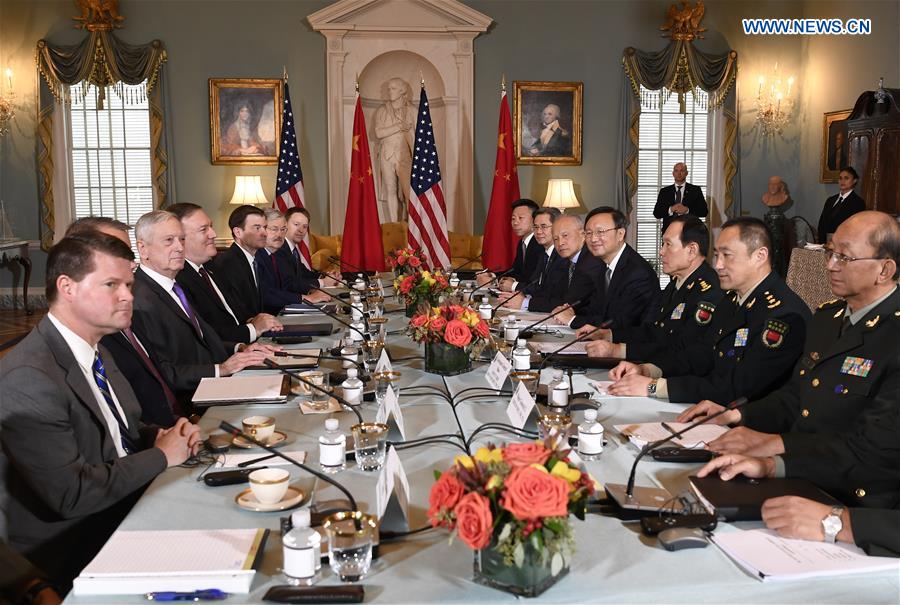
?Yang Jiechi (4th R), a member of the Political Bureau of the Communist Party of China (CPC) Central Committee and director of the Office of the Foreign Affairs Commission of the CPC Central Committee, presides over the second China-U.S. Diplomatic and Security Dialogue in Washington D.C., the United States, on Nov. 9, 2018. (Xinhua/Liu Jie)
WASHINGTON, Nov. 9 (Xinhua) -- Senior Chinese and U.S. officials on Friday said the two countries have vast room for cooperation and they should work jointly to enhance cooperation on trade, military, law enforcement, and counter-terrorism, among others.
Yang Jiechi, a member of the Political Bureau of the Communist Party of China (CPC) Central Committee and also director of the Office of the Foreign Affairs Commission of the CPC Central Committee, co-chaired the second China-U.S. Diplomatic and Security Dialogue with U.S. Secretary of State Mike Pompeo and Secretary of Defense James Mattis.
Chinese State Councilor and Defense Minister Wei Fenghe also participated in the dialogue.
The two sides held in-depth discussion about the preparations for the scheduled meeting between Chinese President Xi Jinping and his U.S. counterpart Donald Trump during the G20 summit in Argentina, and had a thorough exchange on major international and regional issues of common concern.
The dialogue was candid, constructive and produced great results.
For his part, Yang said that Xi and Trump agreed during their telephone conversation on Nov. 1 to work for new progress based on healthy and stable development of relations, and to meet with each other during the upcoming G20 summit.
The two sides spoke highly of the strategic leading role of the two presidents' diplomacy in the bilateral relations, noting that under the current circumstances, their meeting carries great importance to the stability of bilateral ties.
The two sides agreed to strengthen communication, keep close coordination and conduct elaborate preparations to ensure that the important meeting will yield positive results.
In their talks, the Chinese and U.S. officials exchanged their views thoroughly on their own strategic intentions.
The Chinese side said that China will adhere to the socialist path with Chinese characteristics, stick to reform and opening-up and peaceful development, and work with other nations around the world to build a community with a shared future for mankind.
What China has done is to seek better life for its people, rather than challenge or replace any nations, the Chinese officials said.
China has, as always, been a builder of world peace, a contributor to the global development, and a guardian of the international order, they said.
They noted that China firmly sticks to defense-oriented national strategy, and its effort to develop its military in a moderate manner aims to safeguard its national security, not to engage in an arms race with anyone.
China respects the U.S. sovereignty, security and development interest, and the United States should give China reciprocal treatment, they said.
China has committed to working together with the United States for the goals of non-conflict, non-confrontation, mutual respect and win-win cooperation, so as to make positive contributions to the peace, stability and prosperity of the Asia Pacific region and the world at large, the Chinese officials said.
For its part, the U.S. side said that it welcomes China's economic development and success, and it has no intention to contain China.
The U.S. side hopes to develop a constructive and fruitful bilateral relationship based on respect and reciprocity.
The two sides agreed that maintaining the stable development of bilateral ties accords with the fundamental interests of the two peoples as well as those of the international society.
They also agreed to follow the direction and principles set by the two top leaders, manage and control differences on the basis of mutual respect, expand cooperation based on mutual benefit and win-win cooperation, so as to push forward the China-U.S. relationship featuring coordination and cooperation.
MILITARY
Chinese Defense Minister Wei said that China has developed the military-to-military relationship with the United States with the utmost sincerity.
The Chinese military will firmly defend China's sovereignty, territorial integrity and development interests, he said.
Wei expressed the hope that the two sides will respect each other's core interests and major concerns, enhance communication and strengthen mutual trust, so as to make the military-to-military ties a stabilizing factor for the overall bilateral ties.
During the dialogue, the two sides agreed to maintain military communications at various levels, and strengthen mechanism dialogue, in a bid to deepen communication and de-escalate risks.
The two sides will keep up communication to develop a Crisis Deconfliction and Communication Framework, and be committed to implementing the existing Confidence Building Measures.
SOVEREIGNTY-RELATED ISSUES
The Chinese officials highlighted the fact that the Taiwan issue concerns China's sovereignty and territorial integrity and is the most important and sensitive issue between China and the United States.
Taiwan separatists and their actions are the biggest threat to the peace and stability across the Taiwan Strait, the Chinese officials said.
China resolutely opposes the separatists and their actions in Taiwan, and will defend its sovereignty and territorial integrity, they said.
Noting that the one-China principle is the political foundation of China-U.S. relations, Yang and Wei said that China hopes that the U.S. side will honor its commitment to the principle and abide by the three China-U.S. joint communiques, and handle the Taiwan-related issues in a cautious and proper manner.
In this regard, the two senior U.S. officials said that the U.S. government will honor its commitment to the one-China policy, and abide by the three joint communiques.
On the South China Sea issue, China has underlined its indisputable sovereignty over Nansha Islands and its adjacent waters.
While defending its sovereignty and maritime interests and rights, China has been committed to the peaceful settlement of disputes with other claimants through dialogue and consultation, so as to ensure peace and stability in the South China Sea, the senior Chinese officials said.
It is China's legitimate and lawful rights under international law to build civil and necessary defense facilities on its own soil, and such constructions have nothing to do with the so-called militarization, Yang and Wei noted.
They urged the U.S. side to recognize these facts and stop its actions that would undermine China's sovereignty and security interests, and play a constructive role in safeguarding the peace and stability in the South China Sea, and reduce security risks.
Regarding China's Xinjiang Uygur Autonomous Region, Chinese officials said during the dialogue that what happens inside Xinjiang is China's domestic affairs, and foreign nations have no rights to meddle.
China attaches great importance to the socio-economic development in Xinjiang, and has taken a host of measures to advance stability, prosperity, unity and people's wellbeing there, while cracking down on separatist, violent and terrorist activities in a lawful way to safeguard its national security and protect civilians' lives and property, Yang and Wei said.
These measures have achieved remarkable results, as the general social order in Xinjiang has remained stable, with robust economic growth and harmonious coexistence of various ethnic groups, they added.
China expects the U.S. side to respect these facts, view relevant issues in an objective manner and stop meddling in China's domestic affairs, the officials noted.
TRADE
On trade, the senior Chinese and U.S. officials said that the two sides should earnestly implement the consensus reached between the two heads of state during their recent phone talks, support the two countries' economic teams to communicate and consult on issues of mutual concern, so as to reach an agreement that is acceptable for both sides.
Both sides said that there is vast room for them to cooperate, and they should promote their communication and collaboration in such areas as economy and trade, military, law enforcement, anti-terrorism, drug control, and people-to-people exchanges, in a bid to bring more practical benefits to the two peoples.
KOREAN PENINSULA ISSUE
On the Korean Peninsula issue, China reaffirmed its commitment to the denuclearization and peace and stability on the peninsula and adhered to its stance that a solution should be found via dialogue and consultation.
While supporting the United States and the Democratic People's Republic of Korea (DPRK) to engage in direct talks, China hopes that the two sides will step toward each other, accommodate each other's reasonable concerns, accumulate mutual trust, so as to facilitate the complete denuclearization and the establishment of a peace regime on the Korean Peninsula at the same time.
The U.S. side expressed appreciation for China's important and constructive role on the issue.
Both sides believed that the consensus reached between top U.S. and DPRK leaders in their Singapore meeting in June should be implemented in a proactive manner.
As such, the United States and the DPRK should keep close and substantive contact, and relative UN resolutions should be implemented continuously, said the U.S. and Chinese officials.
China and the United States agreed to maintain their communication and consultation concerning the Korean Peninsula issue.
The two sides also compared notes on international and regional issues such as those concerning Afghanistan and the Middle East. They agreed to enhance communication and cooperation and play their positive roles in the proper settlement of these issues.
The two countries had their first Diplomatic and Security Dialogue in June 2017.
