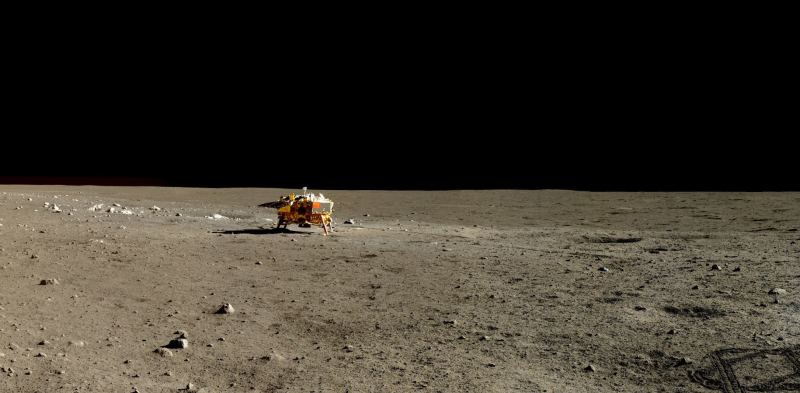
Photo provided by National Astronomical Observatories of Chinese Academy of Sciences shows a high-resolution image of lunar surface on the moon. The image is shot by Chinese Chang'e 3, an unmanned lunar exploration probe, and Yutu rover. (Xinhua)
BEIJING, April 12 (Xinhua) -- China's Chang'e-4 lunar probe is expected to do many things unprecedented in space history after it launches later this year, such as touching down softly on the far side of the Moon and taking the first flowers to blossom on the lifeless lunar surface.
The probe will carry a tin containing seeds of potato and arabidopsis, a small flowering plant related to cabbage and mustard, and probably some silkworm eggs to conduct the first biological experiment on the Moon.
The "lunar mini biosphere" experiment was designed by 28 Chinese universities, led by southwest China' s Chongqing University, a conference on scientific and technological innovation of Chongqing Municipality has heard.
LIFE ON THE MOON
The cylindrical tin, made from special aluminum alloy materials, is 18 cm tall, with a diameter of 16 cm, a net volume of 0.8 liters and a weight of 3 kilograms. The tin will also contain water, a nutrient solution, air and equipment such as a small camera and data transmission system.
Researchers hope the seeds will grow to blossom on the Moon, with the process captured on camera and transmitted to Earth.
Although astronauts have cultivated plants on the International Space Station, and rice and arabidopsis were grown on China's Tiangong-2 space lab, those experiments were conducted in low-Earth orbit, at an altitude of about 400 kilometers. The environment on the Moon, 380,000 kilometers from the Earth, is more complicated.
Liu Hanlong, chief director of the experiment and vice president of Chongqing University, said since the Moon has no atmosphere, its temperature ranges from lower than minus 100 degrees centigrade to higher than 100 degrees centigrade.
"We have to keep the temperature in the 'mini biosphere' within a range from 1 degree to 30 degrees, and properly control the humidity and nutrition. We will use a tube to direct the natural light on the surface of Moon into the tin to make the plants grow," said Xie Gengxin, chief designer of the experiment.
"We want to study the respiration of the seeds and the photosynthesis on the Moon," said Liu.
"Why potato and arabidopsis? Because the growth period of arabidopsis is short and convenient to observe. And potato could become a major source of food for future space travelers," said Liu. "Our experiment might help accumulate knowledge for building a lunar base and long-term residence on the Moon."
The public, especially young people, are being encouraged to participate in the Chang'e-4 mission. The China National Space Administration (CNSA) launched a contest among students across China in 2016, collecting ideas on the design of the payloads.
The "lunar mini biosphere" experiment was selected from more than 200 submissions, according to the CNSA.
THE FAR SIDE
Tidal forces of the Earth have slowed the Moon's rotation to the point where the same side always faces the Earth, a phenomenon called tidal locking. The other face, most of which is never visible from the Earth, is the far side of the Moon.
With its special environment and complex geological history, the far side is a hot spot for scientific and space exploration. However, landing and roving there requires a relay satellite to transmit signals.
It has been reported that China plans to send a relay satellite for Chang'e-4 to the halo orbit of the Earth-Moon Lagrange Point L2 in late May or early June 2018, and then launch the Chang'e-4 lunar lander and rover to the Aitken Basin of the south pole region of the Moon about half a year later.
The Von Karman Crater, named after a Hungarian-American mathematician, aerospace engineer and physicist, in the Aitken Basin, was chosen as the landing site for Chang'e-4. The region is believed to have great scientific research potential.
The transmission channel is limited, and the landscape rugged, so the mission will be more complicated than Chang'e-3, China's first soft landing on the Moon in 2013, said Liu Tongjie, deputy director of the Lunar Exploration and Space Program Center of CNSA.
As the relay satellite will be sent to the Earth-Moon Lagrange Point L2 about 450,000 kilometers from the Earth, where a gravitational equilibrium can be maintained, it could stay in stable orbit and operate for a long time.
"We will make efforts to enable the relay satellite to work as long as possible to serve other probes, including those from other countries," said Ye Peijian,a leading Chinese aerospace expert and consultant to China's lunar exploration program.
The Lunar Exploration and Space Program Center of the CNSA has invited the public to write down their hopes for lunar and space exploration, and those hopes and the names of participants will be carried by the relay satellite into deep space. More than 100,000 people have taken part, according to the center.
INTERNATIONAL COOPERATION
As the far side of the Moon is shielded from electromagnetic interference from the Earth, it's an ideal place to study the space environment and solar bursts, and the probe can "listen" to the deeper reaches of the cosmos, said Liu Tongjie.
The Chang'e-4 probe will also carry scientific payloads developed by the Netherlands, Sweden, Germany and Saudi Arabia.
"The Chinese and Dutch low-frequency radio spectrometers might help us detect 21-cm hydrogen line radiation and study how the earliest stars were ignited and how our cosmos emerged from darkness after the Big Bang," said Chen Xuelei, an astronomer with the National Astronomical Observatories of the Chinese Academy of Sciences.
The rover will also carry an advanced small analyzer, developed in Sweden, to study the interaction between solar winds and the Moon surface.
And a neutron dosimeter, developed in Germany, will be installed on the lander to measure radiation at the landing site. Scientists say it is essential to investigate the radiation environment on the lunar surface in preparation for human missions.